Warts treatment in Bozeman
Common warts are small, grainy skin growths that occur most often on your fingers or hands. Rough to the touch, they also often feature a pattern of tiny black dots (clotted blood vessels).
-
100+ HPV
Strains causing warts
-
6 Types
Of warts treated
-
2–6
Sessions to clear most warts
-
Pediatric
Child-friendly techniques available
Solving Stubborn Warts: When At-Home Kits Fail
Warts can be a source of significant self-consciousness or physical discomfort, especially when located on the hands or the soles of the feet (plantar warts). Many of our patients in Bozeman spend months trying over-the-counter freezing or acid kits, only to see the wart grow back larger or spread to other areas. At SkinCare MT, we provide definitive clinical removals that target the root of the problem.
The Viral Connection
Warts are benign skin growths caused by a viral infection in the top layer of the skin, known as the Human Papillomavirus (HPV). The virus “tricks” the skin into building a protective layer of hard protein (keratin) over it, along with its own tiny blood supply—which is why you often see “black dots” inside a wart. Because it is viral, it is contagious and can spread through small breaks in the skin.
Clinical Removal Protocols at SkinCare MT
We treat various forms of Verruca (ICD-10: B07.x) by destroying the infected tissue and stimulating the body’s own immune system to recognize and fight the virus.
How Treatment Works
We utilize Cryotherapy (liquid nitrogen at -196°C) to create a localized “frostbite” that kills the viral cells. For more resistant warts, we may use Electrosedication or Cantharidin (a blistering agent). This triggers an inflammatory response that “peels” the wart away from the healthy skin underneath, effectively eliminating the viral reservoir.
EVIDENCE-BASED CARE
Our Treatment Approach
We select treatment based on wart type, location, patient age, and prior treatment history — often combining modalities for the fastest, most durable clearance.
Why See a Dermatologist?
- Faster clearance than OTC products
- Access to cantharidin, cryo, laser & immunotherapy
- Prevent spread to family members
- Accurate diagnosis (wart vs. corn vs. skin cancer)
- Safe techniques for children and sensitive areas
- Management of immunosuppressed patients
Warts Types
Which type do you have?
-
Common Warts (Verruca Vulgaris)
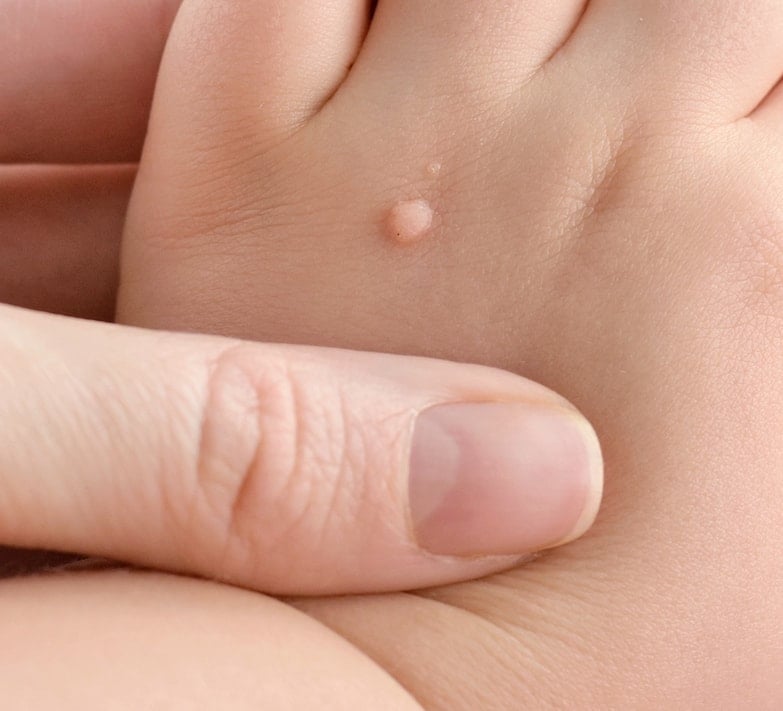
Rough, raised papules with black dots (thrombosed capillaries). Most common on hands, fingers, and knees.
-
Plantar Warts (Verruca Plantaris)
Grow inward under pressure on the soles of feet. Painful with weight-bearing. Often have black dot pattern.
-
Flat Warts (Verruca Plana)
Small, flat, flesh-colored or pink papules. Common on face, legs, and arms — often in clusters.
-
Periungual Warts
Around or under fingernails/toenails. Difficult to treat; risk of nail damage. Require specialist care.
-
Filiform Warts
Thread-like projections, often around the face, eyelids, and neck. Rapid spread if untreated.
-
Molluscum Contagiosum
Small, dome-shaped papules with central dimple. Caused by poxvirus — technically distinct from HPV warts but treated similarly.
PATIENT QUESTIONS
Warts FAQ
Clinical answers from our board-certified dermatologists.
Why do warts have ""seeds"" or black dots in them?
Those little black dots aren’t seeds at all—they are actually tiny, clotted blood vessels (thrombosed capillaries). Warts are “”parasitic”” in nature; they grow their own blood supply to feed the viral growth. Seeing these dots is a clinical sign that we are looking at a true viral wart.
Can I get a wart from a toad?
No. This is a common myth. Warts are caused by the Human Papillomavirus (HPV), which only survives in human skin. You get warts from contact with other people or surfaces that have the virus on them, such as locker room floors or shared towels.
Why won't my wart go away with drugstore freezing kits?
Over-the-counter kits usually only reach about -70°C, which often isn’t cold enough to reach the base of the wart. In our [Location] clinic, we use medical-grade Liquid Nitrogen at $-196°C. This ensures we cause a deep “”thermal shock”” that kills the infected cells and alerts your immune system to the presence of the virus.”
Will they go away on their own?
In many cases, especially in children, the immune system will eventually recognize the virus and clear the warts without treatment. However, this can take months or even years. Treatment is usually recommended if the warts are painful, spreading, or causing cosmetic concern.
Participating Plans and Payment Methods*








* Please not all treatments and procedures are fully covered by insurance, if you are unsure please call our office at (406) 587-4432.